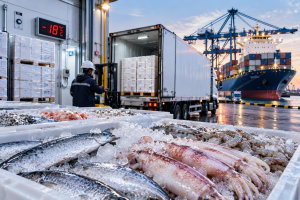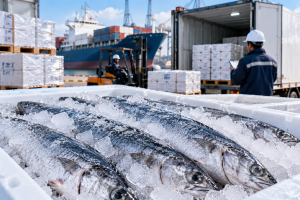


Why the Cold Chain Is the Backbone of Seafood Export – In the world of frozen fish export, maintaining product freshness is not just an expectation — it’s a necessity.
Seafood is one of the most sensitive food commodities, and without proper temperature control, even the freshest catch can quickly lose its quality, flavor, and safety.
For exporters like SAM2BER, which supply frozen fish and seafood from Indonesia to markets such as Korea, Vietnam, Japan, and the Middle East, the cold chain process is the foundation of international trust.
A well-managed cold chain ensures that every product remains fresh, hygienic, and compliant with global food safety standards such as HACCP and GMP.
What Is the Cold Chain Process?
The cold chain refers to a temperature-controlled supply chain that preserves perishable goods from the point of harvest to the final destination. In seafood exports, this involves continuous refrigeration and monitoring across every stage — from fishing boats to processing plants, storage, shipping, and delivery to importers.
The key objective of the cold chain is to maintain product temperature between -18°C and -25°C, preventing bacterial growth and degradation. Each stage of the chain must remain unbroken to guarantee product integrity.
⚙️ Key Stages of the Cold Chain in Frozen Fish Export
To deliver consistent quality, Indonesian frozen seafood exporters follow a detailed cold chain process that includes several critical steps:
1. Harvesting and Onboard Handling
Once fish are caught, immediate action is taken to preserve freshness. They are cleaned, iced, and stored in refrigerated compartments on fishing vessels.
The quicker the fish are chilled after harvest, the better the preservation of taste, texture, and color.
2. Processing and Quick Freezing
At the HACCP-certified seafood factory, the fish are processed — cleaned, filleted, graded, and packed.
The core technology used here is IQF (Individual Quick Freezing), which rapidly freezes the fish at very low temperatures.
This technique locks in natural moisture and nutrients, ensuring the fish maintain high quality even after long-distance export.
3. Frozen Storage and Quality Monitoring
After freezing, products are moved to cold storage warehouses maintained at consistent sub-zero temperatures.
Temperature and humidity are continuously monitored using digital sensors.
Any deviation can trigger an automatic alert to prevent spoilage.
4. Loading and Transport
During transport to ports, the products are moved using refrigerated trucks that maintain the cold chain.
Proper insulation and handling prevent temperature fluctuations during transfer from warehouse to container.
5. Export and Shipping
Frozen fish are shipped in reefer containers — specially designed refrigerated units that maintain set temperatures during international transit.
Shipping companies and exporters collaborate to track every shipment in real time, ensuring compliance with both Indonesian and import-country regulations.
Maintaining Compliance with Global Standards
In international seafood trade, maintaining a continuous cold chain is not only a quality requirement but also a regulatory obligation.
Countries like Korea, Japan, and the EU require importers to present proof of cold chain management during inspection.
To meet these requirements, exporters like SAM2BER provide:
- Temperature log reports from fishing to delivery.
- Health Certificates issued by Indonesia’s Ministry of Marine Affairs and Fisheries.
- HACCP and GMP certifications as proof of food safety compliance.
- Batch traceability documents linking each shipment to production data.
By ensuring transparency in every shipment, Indonesian seafood exporters strengthen buyer confidence and avoid costly rejections at import terminals.
The Role of Technology in Cold Chain Management
Modern cold chain logistics in Indonesia has evolved significantly thanks to technology.
From IoT-based sensors to GPS tracking, exporters now have the tools to monitor temperature and humidity at every step of the export journey.
Key technologies used in the seafood cold chain:
- IoT Temperature Sensors: Real-time monitoring of reefer containers and cold storage.
- Blockchain Traceability: Digital records of product movement for quality verification.
- Automated Alerts: Instant notification when temperature deviations occur.
- Cloud-Based Reporting: Centralized system to generate export compliance documentation.
With these systems, frozen seafood exporters can ensure maximum product safety while minimizing manual errors and energy waste.
Why Cold Chain Integrity Matters to Buyers
For international buyers — distributors, importers, and restaurant chains — cold chain integrity is a key indicator of reliability.
A single temperature breach during shipping can result in a complete shipment rejection, leading to financial losses and damaged reputation.
Buyers from Korea and Vietnam often require exporters to provide:
- Verified temperature records for every shipment.
- Photos of cold storage and freezing facilities.
- Copies of HACCP certification and packaging compliance.
Therefore, exporters who consistently maintain a reliable cold chain gain a competitive edge in the global seafood market.
Indonesia’s Advantage in Frozen Seafood Export
Indonesia’s geographical position and natural abundance make it one of the most competitive seafood exporters in the world.
Combined with advanced cold chain logistics and strong government oversight, the country continues to expand its presence in premium markets.
Competitive advantages of Indonesia’s seafood export industry:
- Year-round access to fresh marine resources.
- Growing number of HACCP-certified seafood factories.
- Well-developed cold chain infrastructure and shipping network.
- Experienced exporters with global partnerships.
As demand for high-quality frozen seafood continues to rise, Indonesia’s exporters — led by companies like SAM2BER — are ready to meet global expectations with professionalism and precision.
Conclusion: A Cold Chain Built on Trust and Technology
The cold chain supports every successful frozen fish export. It ensures that seafood caught in Indonesia’s rich oceans arrives at global destinations in pristine condition.
For companies like SAM2BER, managing this process means combining modern technology, international compliance, and deep industry expertise to deliver products that global buyers can trust.